|
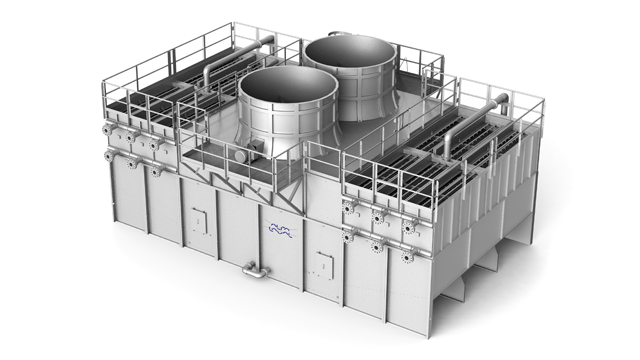
Heavy Duty Construction
The Niagara Wet Surface Air Coolers (WSAC) are designed and
built for rugged and long lasting industrial applications.
Niagara uses heavy gauge steel construction which is double
brake flanged on all four sides and welded in all corners
providing extreme rigidity, extended service life and
durability. All metal fabrication is completed and tested in
Buffalo New York before shipment to the job site.
|

Spray Water and Fan Testing |
|
H.D.G.A.F
Standard Niagara units are Hot Dipped
Galvanized After Fabrication (H.D.G.A.F) according to
ASTM A123.
Zinc provides 42% more fighting resistance to rust and
corrosion versus raw exposed steel. Dipping insures that all
surfaces and machined edges are well coated. Niagara's
competitors use mill galvanized material which results in a
significantly thinner layer of zinc and less protection against
material degradation.
|

H.D.G.A.F. |
|
Alternate Material Construction
Since Niagara engineers every job from scratch, almost any
material can be specified. Niagara offers optional 100%
stainless steel construction and thick walled tubes for maximum
protection and service life. Other materials include titanium,
brass, copper, etc. |
|
Custom Tube Bundles
Niagara WSAC’s are “closed loop” which means that the process
stream being cooled or condensed is never exposed to ambient air
where airborne matter can contaminate it. Cooling tubes can be
designed either in a serpentine or straight through and
cleanable bundle depending on service requirements. |

Serpentine
Cleanable
|
|
Tube bundles can sustain an operating pressure of 2500psi and
can be
designed in accordance with ASME code standards with all
materials in contact with the process stream having full ASME
material certification. Existing piping can be arranged and
valved so that any tube bundle can be taken out of service for
maintenance while the unit is operating.
|
|
Poor Quality Makeup Water
With the growing
concern of water usage, Niagara WSAC’s can use poor quality
water as spray to reduce fresh water consumption. Typical
examples of water sources include blowdown from existing cooling
towers, wastewater, river water, pond water, etc. Wide tube
spacing in conjunction with low pressure/high volume nozzles
allows spray water to be run at high cycles of concentration, up
to 50 cycles in some cases, thereby
reducing water
consumption up to 70% annually.
|
|
High Efficiency Fans
All fan assemblies are designed to give maximum fan
efficiency and long life when handling saturated air at high
velocities. A WSAC is sized to reject heat at the most difficult
condition: full heat load at the highest expected wet bulb air
temperature. Most WSAC fans operate in On or Off modes with the
fans automatically switching Off when the process outlet
temperature begins to drop. Individual blades are adjustable
pitch and can be either cast aluminum or FRP. Fans smaller than
5 foot diameter are directly connected to marine duty, Totally
Enclosed Air Over (TEAO) motors. Fan greater than 5 foot
diameter fan utilize TEFC, NEMA approved motors with fiberglass
reinforced epoxy fin blades. Fan stacks are installed with
access doors for system maintenance and inspection. |
 |
|

|
|
Accurate
Temperature Control
Changing the air flow rate over the tube bundles very
effectively controls the fluid outlet temperature. Multiple fans
operating in parallel are used to induce the required air volume
needed to evaporate the application’s heat load (as opposed to a
single large diameter fan). This allows utilization of a number
of different process temperature control schemes.
Variable Frequency Drive (VFD) fans can be used to increase or
decrease the air flow rate depending on the process outlet
temperature. The precision of a VFD is greater than the On/Off
scheme and can maintain outlet temperatures at +0 / -2.5 degrees
F relative to the set point. VFD's can reduce the air rate
automatically when the process outlet temperature begins to drop
due to lower heat loads or reduced wet bulb temperatures.
Simple RTD monitoring of outlet fluid temperature can be
combined with logic control so to effectively modulate heat
rejection capacity of the WSAC. Inlet vs. outlet temperature
monitoring (delta T – cooling range) can permit capacity control
functions to further improve response times relative to the set
point. |
 |
|

|
|
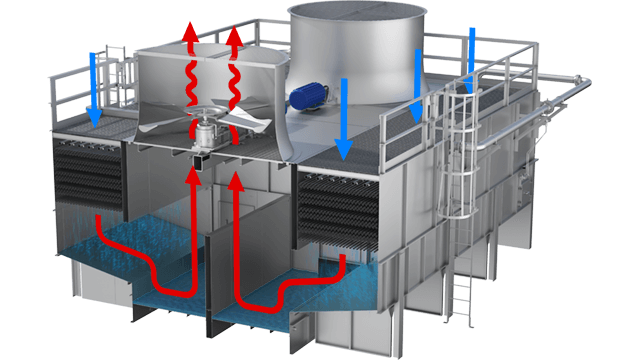
Induced Draft
The Niagara units are induced draft
co-current flow. Because of this arrangement, the pressure
inside the casing and coil section is negative. Negative
pressure is the best way to uniformly distributing of air over
the tube bundles. The co-current flow (air and spray water
traveling in the same direction) also insures proper
distribution of the spray water over each tube. In
counter-current flow, turbulent spots on the tubes prevent water
from covering the entire tube surface. This causes hot spots
that lead to deposits and scaling, thus affecting performance
over time. Niagara’s high velocity discharge prevents
recirculation of moist air back into the inlet of the unit.
Additionally the Niagara arrangement does not require drift
eliminators. Since there is no pressure drop across the drift
eliminator section, as much as 15% less fan energy is required.
High Velocity Discharge
Niagara discharges the saturated air at high velocity to prevent
recirculation back to the inlet of the unit. Even with a high
discharge rate, Niagara’s tube bundle and fan arrangement does
not require drift eliminators. This is due to the two 90 degree
turns the air is forced to make before being exhausted. Most of
the water drops out of the air-stream before it reaches the
fans. Since there is no pressure drop across the drift
eliminator section, as much as 15% less fan energy is required. |

Counter-Current Flow
|
|
Drenching Spray System
Spray water distribution employs a low pressure high flow design
with full flood spray pattern to provide optimum tube bundle
drenching. Inspection and service of the spray nozzles can be
accomplished without removing any appurtenances while the
equipment is in operation. Access packages and walkways are
available from Niagara to further assist maintenance personnel
with nozzle and bundle inspection. The spray system will also be
arranged so that an individual tube bundles may be hydraulically
isolated for service or control. |
 |
|
Hardware
Niagara construction employs drill through holes with nut and
bolt fasteners. Drill through hardware sustains a much longer
service life versus self tapping metal screws. |
|
Low Energy
The co-current design of the Niagara WSAC does not require mist
eliminators to remove the water droplets from the discharge air
stream. Mist eliminators increase the static pressure load by
approximately 15%. This increased pressure drop requirement
directly equates to higher power consumption. The Niagara WSAC
also has a lower unit profile which reduces the spray water
pumping head requirement by approximately 20%. |
|
|
|
|